Between portraiture, fashion, and the imagination: Marie Fargues’s painting captures 18th-century Europe’s fascination with the Ottoman world—through turquerie, travel, storytelling, and the longing for a freer, more universal “elsewhere”
A Portrait from Outside Europe
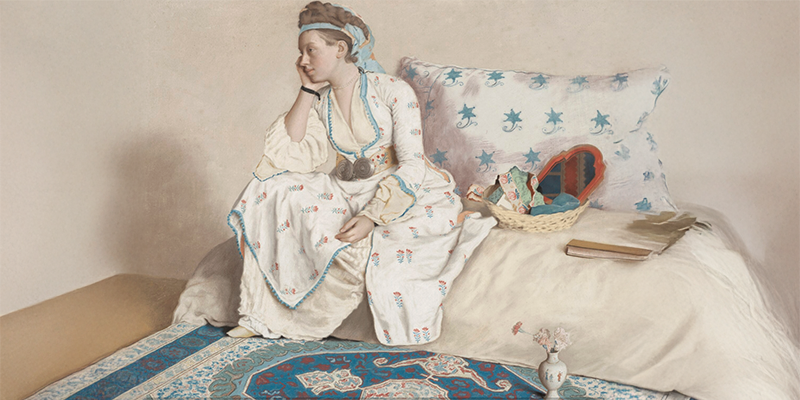
Marie Fargues was not yet thirty when, in 1756, she married in Amsterdam a painter whose services were in demand at the major courts of Europe: Jean-Etienne Liotard. Shortly after their wedding, he painted her portrait in an extraordinary manner. Lost in thought, her hand to her face, supporting her head and her thoughts, Marie sits on a low, puffy cushion, with another—made of pearlescent silk dotted with blue flowers—leaning against the wall; together they seem to form a bed, but it is actually a “Turkish-style” sofa, as they called it back then. At the woman’s feet, too, lies a rug that could not be more Turkish. And she wears a white caftan edged in blue, fastened with an embroidered sash that closes with a buckle made of two embossed silver discs. Her hair is braided into a style with various drapes: a veritable turban.
The “Turkish painter” of the courts
This is not the first time Liotard has used the “Turkish portrait.” He had been to Constantinople, lived there for years, and there produced various sketches from life of Turkish women, captured in their everyday gestures and settings amid silks and turbans. This composition with an exotic touch became one of his most sought-after creations: from Maria Gunning, Countess of Coventry, to Marie-Adélaïde of France, daughter of King Louis XV. At a certain point, every grand dame demanded a “sultana” portrait, a “harem woman” portrait: there was Madame de Pompadour and even Empress Maria Theresa of Austria. Other painters entered the scene, but Liotard was the only “Turkish painter,” the sole artist to have lived at the Eastern Gate and to sport a long Turkish beard—highly unusual for European courts—which is strikingly evident in his self-portraits.
When the Exotic Becomes Fashion
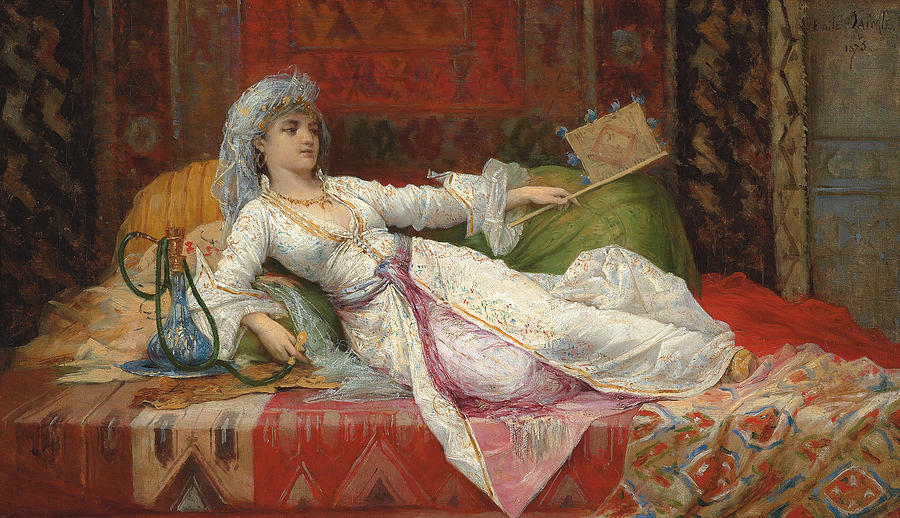
It is the era of turquerie, or “Turkish-style,” that is, the fascination—both fantastical and literary—with the Ottoman world, which in Europe captivated intellectuals, artists, and members of high society. A veritable infatuation with the customs and traditions of a people who are no longer the millennia-old ferocious threat (“Mamma li turchi!”), but rather an object of admiration, to be imitated. An exotic, mythical, and seductive dream, as intoxicating as the scent of spices.
The Hammam and the Female Gaze
Among the first travelers to contribute to the narrative of this idealized “elsewhere” was Lady Mary Wortley Montagu, who accompanied her ambassador husband to Constantinople between 1716 and 1718. In her *Letters from the Turkish Embassy*, she bears witness to a place off-limits to every other European traveler: the *hammam*, or Turkish bath, where that all-female ritual of personal cleansing and socializing takes place, in which, amid chatter and gossip, the city’s latest news is discussed, and which Lady Montagu describes as “the women’s café.”
Not Just a Fad: The Longing for Another World
But Turcomania, the exoticism of the 18th century, is not just a fad. All those odalisques at the bathhouse, those fountains, those sofas, those wise sultans, actually conceal the search for a better elsewhere, a utopia. This is why Enlightenment intellectuals remain fascinated by the “Turk,” because it represents the discovery of the other: the dream of a civilization above nations, universal, where a harmony impossible here reigns.